


Weekly Spirit of Prophecy Reading
Chapter 62—The Anointing of David
This chapter is based on 1 Samuel 16:1-13.
A few miles south of Jerusalem, “the city of the great King,” is Bethlehem, where David, the son of Jesse, was born more than a thousand years before the infant Jesus was cradled in the manger and worshiped by the Wise Men from the East. Centuries before the advent of the Saviour, David, in the freshness of boyhood, kept watch of his flocks as they grazed on the hills surrounding Bethlehem. The simple shepherd boy sang the songs of his own composing, and the music of his harp made a sweet accompaniment to the melody of his fresh young voice. The Lord had chosen David, and was preparing him, in his solitary life with his flocks, for the work He designed to commit to his trust in after years.
While David was thus living in the retirement of his humble shepherd’s life, the Lord God was speaking about him to the prophet Samuel. “And the Lord said unto Samuel, How long wilt thou mourn for Saul, seeing I have rejected him from reigning over Israel? fill thine horn with oil, and go, I will send thee to Jesse the Bethlehemite: for I have provided Me a king among his sons.... Take an heifer with thee, and say, I am come to sacrifice to the Lord. And call Jesse to the sacrifice, and I will show thee what thou shalt do: and thou shalt anoint unto Me him whom I name unto thee. And Samuel did that which the Lord spake, and came to Bethlehem. And the elders of the town trembled at his coming, and said, Comest thou peaceably? And he said, Peaceably.” The elders accepted an invitation to the sacrifice, and Samuel called also Jesse and his sons. The altar was built and the sacrifice was ready. All the household of Jesse were present, with the exception of David, the youngest son, who had been left to guard the sheep, for it was not safe to leave the flocks unprotected.
When the sacrifice was ended, and before partaking of the offering feast, Samuel began his prophetic inspection of the noble-appearing sons of Jesse. Eliab was the eldest, and more nearly resembled Saul for stature and beauty than the others. His comely features and finely developed form attracted the attention of the prophet. As Samuel looked upon his princely bearing, he thought, “This is indeed the man whom God has chosen as successor to Saul,” and he waited for the divine sanction that he might anoint him. But Jehovah did not look upon the outward appearance. Eliab did not fear the Lord. Had he been called to the throne, he would have been a proud, exacting ruler. The Lord’s word to Samuel was, “Look not on his countenance, or on the height of his stature; because I have refused him: for the Lord seeth not as man seeth; for man looketh on the outward appearance, but the Lord looketh on the heart.” No outward beauty can recommend the soul to God. The wisdom and excellence revealed in the character and deportment, express the true beauty of the man; and it is the inner worth, the excellency of the heart, that determines our acceptance with the Lord of hosts. How deeply should we feel this truth in the judgment of ourselves and others. We may learn from the mistake of Samuel how vain is the estimation that rests on beauty of face or nobility of stature. We may see how incapable is man’s wisdom of understanding the secrets of the heart or of comprehending the counsels of God without special enlightenment from heaven. The thoughts and ways of God in relation to His creatures are above our finite minds; but we may be assured that His children will be brought to fill the very place for which they are qualified, and will be enabled to accomplish the very work committed to their hands, if they will but submit their will to God, that His beneficent plans may not be frustrated by the perversity of man.
Eliab passed from the inspection of Samuel, and the six brothers who were in attendance at the service followed in succession to be observed by the prophet; but the Lord did not signify His choice of any one of them. With painful suspense Samuel had looked upon the last of the young men; the prophet was perplexed and bewildered. He inquired of Jesse, “Are here all thy children?” The father answered, “There remaineth yet the youngest, and behold, he keepeth the sheep.” Samuel directed that he should be summoned, saying, “We will not sit down till he come hither.”
The lonely shepherd was startled by the unexpected call of the messenger, who announced that the prophet had come to Bethlehem and had sent for him. With surprise he questioned why the prophet and judge of Israel should desire to see him; but without delay he obeyed the call. “Now he was ruddy, and withal of a beautiful countenance, and goodly to look to.” As Samuel beheld with pleasure the handsome, manly, modest shepherd boy, the voice of the Lord spoke to the prophet, saying, “Arise, anoint him: for this is he.” David had proved himself brave and faithful in the humble office of a shepherd, and now God had chosen him to be captain of His people. “Then Samuel took the horn of oil, and anointed him in the midst of [from among] his brethren: and the Spirit of the Lord came upon David from that day forward.” The prophet had accomplished his appointed work, and with a relieved heart he returned to Ramah.
Samuel had not made known his errand, even to the family of Jesse, and the ceremony of anointing David had been performed in secret. It was an intimation to the youth of the high destiny awaiting him, that amid all the varied experiences and perils of his coming years, this knowledge might inspire him to be true to the purpose of God to be accomplished by his life.
The great honor conferred upon David did not serve to elate him. Notwithstanding the high position which he was to occupy, he quietly continued his employment, content to await the development of the Lord’s plans in His own time and way. As humble and modest as before his anointing, the shepherd boy returned to the hills and watched and guarded his flocks as tenderly as ever. But with new inspiration he composed his melodies and played upon his harp. Before him spread a landscape of rich and varied beauty. The vines, with their clustering fruit, brightened in the sunshine. The forest trees, with their green foliage, swayed in the breeze. He beheld the sun flooding the heavens with light, coming forth as a bridegroom out of his chamber and rejoicing as a strong man to run a race. There were the bold summits of the hills reaching toward the sky; in the faraway distance rose the barren cliffs of the mountain wall of Moab; above all spread the tender blue of the overarching heavens. And beyond was God. He could not see Him, but His works were full of His praise. The light of day, gilding forest and mountain, meadow and stream, carried the mind up to behold the Father of lights, the Author of every good and perfect gift. Daily revelations of the character and majesty of his Creator filled the young poet’s heart with adoration and rejoicing. In contemplation of God and His works the faculties of David’s mind and heart were developing and strengthening for the work of his afterlife. He was daily coming into a more intimate communion with God. His mind was constantly penetrating into new depths for fresh themes to inspire his song and to wake the music of his harp. The rich melody of his voice poured out upon the air, echoed from the hills as if responsive to the rejoicing of the angels’ songs in heaven.
Who can measure the results of those years of toil and wandering among the lonely hills? The communion with nature and with God, the care of his flocks, the perils and deliverances, the griefs and joys, of his lowly lot, were not only to mold the character of David and to influence his future life, but through the psalms of Israel’s sweet singer they were in all coming ages to kindle love and faith in the hearts of God’s people, bringing them nearer to the ever-loving heart of Him in whom all His creatures live.
David, in the beauty and vigor of his young manhood, was preparing to take a high position with the noblest of the earth. His talents, as precious gifts from God, were employed to extol the glory of the divine Giver. His opportunities of contemplation and meditation served to enrich him with that wisdom and piety that made him beloved of God and angels. As he contemplated the perfections of his Creator, clearer conceptions of God opened before his soul. Obscure themes were illuminated, difficulties were made plain, perplexities were harmonized, and each ray of new light called forth fresh bursts of rapture, and sweeter anthems of devotion, to the glory of God and the Redeemer. The love that moved him, the sorrows that beset him, the triumphs that attended him, were all themes for his active thought; and as he beheld the love of God in all the providences of his life, his heart throbbed with more fervent adoration and gratitude, his voice rang out in a richer melody, his harp was swept with more exultant joy; and the shepherd boy proceeded from strength to strength, from knowledge to knowledge; for the Spirit of the Lord was upon him.
Chapter 63—David and Goliath
This chapter is based on 1 Samuel 16:14-23; 17.
When King Saul realized that he had been rejected by God, and when he felt the force of the words of denunciation that had been addressed to him by the prophet, he was filled with bitter rebellion and despair. It was not true repentance that had bowed the proud head of the king. He had no clear perception of the offensive character of his sin, and did not arouse to the work of reforming his life, but brooded over what he thought was the injustice of God in depriving him of the throne of Israel and in taking the succession away from his posterity. He was ever occupied in anticipating the ruin that had been brought upon his house. He felt that the valor which he had displayed in encountering his enemies should offset his sin of disobedience. He did not accept with meekness the chastisement of God; but his haughty spirit became desperate, until he was on the verge of losing his reason. His counselors advised him to seek for the services of a skillful musician, in the hope that the soothing notes of a sweet instrument might calm his troubled spirit. In the providence of God, David, as a skillful performer upon the harp, was brought before the king. His lofty and heaven-inspired strains had the desired effect. The brooding melancholy that had settled like a dark cloud over the mind of Saul was charmed away.
When his services were not required at the court of Saul, David returned to his flocks among the hills and continued to maintain his simplicity of spirit and demeanor. Whenever it was necessary, he was recalled to minister before the king, to soothe the mind of the troubled monarch till the evil spirit should depart from him. But although Saul expressed delight in David and his music, the young shepherd went from the king’s house to the fields and hills of his pasture with a sense of relief and gladness.
David was growing in favor with God and man. He had been instructed in the way of the Lord, and he now set his heart more fully to do the will of God than ever before. He had new themes for thought. He had been in the court of the king and had seen the responsibilities of royalty. He had discovered some of the temptations that beset the soul of Saul and had penetrated some of the mysteries in the character and dealings of Israel’s first king. He had seen the glory of royalty shadowed with a dark cloud of sorrow, and he knew that the household of Saul, in their private life, were far from happy. All these things served to bring troubled thoughts to him who had been anointed to be king over Israel. But while he was absorbed in deep meditation, and harassed by thoughts of anxiety, he turned to his harp, and called forth strains that elevated his mind to the Author of every good, and the dark clouds that seemed to shadow the horizon of the future were dispelled.
God was teaching David lessons of trust. As Moses was trained for his work, so the Lord was fitting the son of Jesse to become the guide of His chosen people. In his watchcare for his flocks, he was gaining an appreciation of the care that the Great Shepherd has for the sheep of His pasture.
The lonely hills and the wild ravines where David wandered with his flocks were the lurking place of beasts of prey. Not infrequently the lion from the thickets by the Jordan, or the bear from his lair among the hills, came, fierce with hunger, to attack the flocks. According to the custom of his time, David was armed only with his sling and shepherd’s staff; yet he early gave proof of his strength and courage in protecting his charge. Afterward describing these encounters, he said: “When there came a lion, or a bear, and took a lamb out of the flock, I went out after him, and smote him, and delivered it out of his mouth: and when he arose against me, I caught him by his beard, and smote him, and slew him.” 1 Samuel 17:34, 35, R.V. His experience in these matters proved the heart of David and developed in him courage and fortitude and faith.
Even before he was summoned to the court of Saul, David had distinguished himself by deeds of valor. The officer who brought him to the notice of the king declared him to be “a mighty valiant man, and a man of war, and prudent in matters,” and he said, “The Lord is with him.”
When war was declared by Israel against the Philistines, three of the sons of Jesse joined the army under Saul; but David remained at home. After a time, however, he went to visit the camp of Saul. By his father’s direction he was to carry a message and a gift to his elder brothers and to learn if they were still in safety and health. But, unknown to Jesse, the youthful shepherd had been entrusted with a higher mission. The armies of Israel were in peril, and David had been directed by an angel to save his people.
As David drew near to the army, he heard the sound of commotion, as if an engagement was about to begin. And “the host was going forth to the fight, and shouted for the battle.” Israel and the Philistines were drawn up in array, army against army. David ran to the army, and came and saluted his brothers. While he was talking with them, Goliath, the champion of the Philistines, came forth, and with insulting language defied Israel and challenged them to provide a man from their ranks who would meet him in single combat. He repeated his challenge, and when David saw that all Israel were filled with fear, and learned that the Philistine’s defiance was hurled at them day after day, without arousing a champion to silence the boaster, his spirit was stirred within him. He was fired with zeal to preserve the honor of the living God and the credit of His people.
The armies of Israel were depressed. Their courage failed. They said one to another, “Have ye seen this man that is come up? surely to defy Israel is he come up.” In shame and indignation, David exclaimed, “Who is this uncircumcised Philistine, that he should defy the armies of the living God?”
Eliab, David’s eldest brother, when he heard these words, knew well the feelings that were stirring the young man’s soul. Even as a shepherd, David had manifested daring, courage, and strength but rarely witnessed; and the mysterious visit of Samuel to their father’s house, and his silent departure, had awakened in the minds of the brothers suspicions of the real object of his visit. Their jealousy had been aroused as they saw David honored above them, and they did not regard him with the respect and love due to his integrity and brotherly tenderness. They looked upon him as merely a stripling shepherd, and now the question which he asked was regarded by Eliab as a censure upon his own cowardice in making no attempt to silence the giant of the Philistines. The elder brother exclaimed angrily, “Why camest thou down hither? and with whom hast thou left those few sheep in the wilderness? I know thy pride, and the naughtiness of thine heart; for thou art come down that thou mightest see the battle.” David’s answer was respectful but decided: “What have I now done? Is there not a cause?”
The words of David were repeated to the king, who summoned the youth before him. Saul listened with astonishment to the words of the shepherd, as he said, “Let no man’s heart fail because of him; thy servant will go and fight with this Philistine.” Saul strove to turn David from his purpose, but the young man was not to be moved. He replied in a simple, unassuming way, relating his experiences while guarding his father’s flocks. And he said, “The Lord that delivered me out of the paw of the lion, and out of the paw of the bear, He will deliver me out of the hand of this Philistine. And Saul said unto David, Go, and the Lord be with thee.”
For forty days the host of Israel had trembled before the haughty challenge of the Philistine giant. Their hearts failed within them as they looked upon his massive form, in height measuring six cubits and a span. Upon his head was a helmet of brass, he was clothed with a coat of mail that weighed five thousand shekels, and he had greaves of brass upon his legs. The coat was made of plates of brass that overlaid one another, like the scales of a fish, and they were so closely joined that no dart or arrow could possibly penetrate the armor. At his back the giant bore a huge javelin, or lance, also of brass. “The staff of his spear was like a weaver’s beam; and his spear’s head weighed six hundred shekels of iron; and one bearing a shield went before him.”
Morning and evening Goliath had approached the camp of Israel, saying with a loud voice, “Why are ye come out to set your battle in array? am not I a Philistine, and ye servants to Saul? choose you a man for you, and let him come down to me. If he be able to fight with me, and to kill me, then will we be your servants: but if I prevail against him, and kill him, then shall ye be our servants, and serve us. And the Philistine said, I defy the armies of Israel this day; give me a man, that we may fight together.”
Though Saul had given David permission to accept Goliath’s challenge, the king had small hope that David would be successful in his courageous undertaking. Command was given to clothe the youth in the king’s own armor. The heavy helmet of brass was put upon his head, and the coat of mail was placed upon his body; the monarch’s sword was at his side. Thus equipped, he started upon his errand, but erelong began to retrace his steps. The first thought in the minds of the anxious spectators was that David had decided not to risk his life in meeting an antagonist in so unequal an encounter. But this was far from the thought of the brave young man. When he returned to Saul he begged permission to lay aside the heavy armor, saying, “I cannot go with these; for I have not proved them.” He laid off the king’s armor, and in its stead took only his staff in his hand, with his shepherd’s scrip and a simple sling. Choosing five smooth stones out of the brook, he put them in his bag, and, with his sling in his hand, drew near to the Philistine. The giant strode boldly forward, expecting to meet the mightiest of the warriors of Israel. His armor-bearer walked before him, and he looked as if nothing could withstand him. As he came nearer to David he saw but a stripling, called a boy because of his youth. David’s countenance was ruddy with health, and his well-knit form, unprotected by armor, was displayed to advantage; yet between its youthful outline and the massive proportions of the Philistine, there was a marked contrast.
Goliath was filled with amazement and anger. “Am I a dog,” he exclaimed, “that thou comest to me with staves?” Then he poured upon David the most terrible curses by all the gods of his knowledge. He cried in derision, “Come to me, and I will give thy flesh unto the fowls of the air, and to the beasts of the field.”
David did not weaken before the champion of the Philistines. Stepping forward, he said to his antagonist: “Thou comest to me with a sword, and with a spear, and with a shield: but I come to thee in the name of the Lord of hosts, the God of the armies of Israel, whom thou hast defied. This day will the Lord deliver thee into mine hand; and I will smite thee, and take thine head from thee; and I will give the carcasses of the host of the Philistines this day unto the fowls of the air, and to the wild beasts of the earth; that all the earth may know that there is a God in Israel. And all this assembly shall know that the Lord saveth not with sword and spear: for the battle is the Lord’s, and He will give you into our hands.”
There was a ring of fearlessness in his tone, a look of triumph and rejoicing upon his fair countenance. This speech, given in a clear, musical voice, rang out on the air, and was distinctly heard by the listening thousands marshaled for war. The anger of Goliath was roused to the very highest heat. In his rage he pushed up the helmet that protected his forehead and rushed forward to wreak vengeance upon his opponent. The son of Jesse was preparing for his foe. “And it came to pass, when the Philistine arose, and came and drew nigh to meet David, that David hasted, and ran toward the army to meet the Philistine. And David put his hand in his bag, and took thence a stone, and slang it, and smote the Philistine in the forehead, that the stone sunk into his forehead; and he fell upon his face to the earth.”
Amazement spread along the lines of the two armies. They had been confident that David would be slain; but when the stone went whizzing through the air, straight to the mark, they saw the mighty warrior tremble, and reach forth his hands, as if he were struck with sudden blindness. The giant reeled, and staggered, and like a smitten oak, fell to the ground. David did not wait an instant. He sprang upon the prostrate form of the Philistine, and with both hands laid hold of Goliath’s heavy sword. A moment before, the giant had boasted that with it he would sever the youth’s head from his shoulders and give his body to the fowls of the air. Now it was lifted in the air, and then the head of the boaster rolled from his trunk, and a shout of exultation went up from the camp of Israel.
The Philistines were smitten with terror, and the conclusion which ensued resulted in a precipitate retreat. The shouts of the triumphant Hebrews echoed along the summits of the mountains, as they rushed after their fleeing enemies; and they “pursued the Philistines, until thou come to the valley, and to the gates of Ekron. And the wounded of the Philistines fell down by the way to Shaaraim, even unto Gath, and unto Ekron. And the children of Israel returned from chasing after the Philistines, and they spoiled their tents. And David took the head of the Philistine, and brought it to Jerusalem; but he put his armor in his tent.”
Featured Resources
Prayer
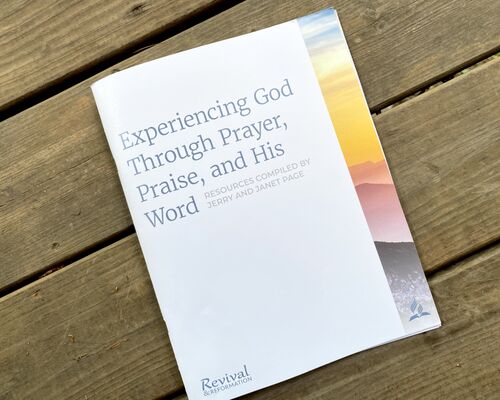
Experiencing God through Prayer and Praise - Newly Updated
This newly updated inspirational packet, compiled by Jerry and Janet Page, contains many resources on prayer including topics like: Praising God, abiding in Jesus’ love, guidelines for those desiring anointing, encouraging promises and quotes on healing, principles of intercessory prayer, how to pray with your spouse, powerful promises for parents, what to pray for non-Christians, when Satan called a worldwide meeting, and much more. (Download the entire packet or choose topics individually.)
Prayer

Promises to Claim for the Outpouring of the Holy Spirit
The following is a collection of Bible promises and Spirit of Prophecy quotes that we can claim as we pray for a deeper outpouring of the Holy Spirit in our lives and church. God is faithful. His Word does not return unto Him void. Claim these promises! God will answer! In addition to this collection of quotes, we are also offering the free booklet "God Still Lives" for download. This book shows in living reality what Holy Spirit living looks like. We know you will be blessed! Dare to ask for more!
Revival

Revival NOW!
Revival NOW! is a definite "must read" for anyone hungering for revival! This popular booklet, compiled by Dan Augsburger, has already printed over 15,000 copies and has been shared worldwide. Topics covered include: God’s Wonderful Gift of Pardon and Righteousness, Being Transformed, Adopting Christ’s Lifestyle Of Obedience and Service, What Was/Is The Condition Of God’s People, God’s Remedy And The Pathway To Revival, and much more! (All 64 pages are pure gold!)